
Language plays a key role in the development of the young child. Through language, a child learns to express themselves, form relationships, express emotions, and understand the world. At the same time, research shows that language delays often begin before the age of five. This makes childcare an important place to monitor, strengthen, and, where necessary, intervene early in the language development of young children.
Childcare organization Kibeo aims to provide every child with the richest possible language foundation. The new language program, Taalrijk, gives concrete form to this in daily practice. “Taalrijk was developed based on the conviction that every child, regardless of background, deserves equal opportunities to develop a strong language foundation,” says Danina de Vries, Pedagogical Policy Officer at Kibeo. “The more enjoyment and self-confidence children experience with language, the greater the chance that they will develop skills that last a lifetime.”
Why the first years matter
The first years of life are a sensitive period for language development. During this phase, the brain develops rapidly, and the foundation is laid for later language, reading, and school skills. Many young children spend part of their week in childcare, where language is constantly present. For children who hear less language at home, this rich language environment is an important supplement. The connection with the Dutch language is also important for children growing up with multiple languages.
At Kibeo, language stimulation was already a natural part of daily pedagogical practice. Pedagogical professionals read aloud, hold conversations, sing, and play along. At the same time, a need arose for more coherence, depth, and awareness. Not as a standalone program, but integrated into daily practice. This is how Taalrijk came into being: a language program for children that offers language as something experienced together, rather than as a separate moment.
A rich language foundation for every child
Taalrijk focuses on increasing the quantity of language, but above all on the quality of language interactions. Meaningful conversations, repetition, connecting with the child's world of experience, and room for personal input are central. In doing so, the program aligns with what we know about language development, but also offers extra support to children at risk of falling behind.
More than furnishing
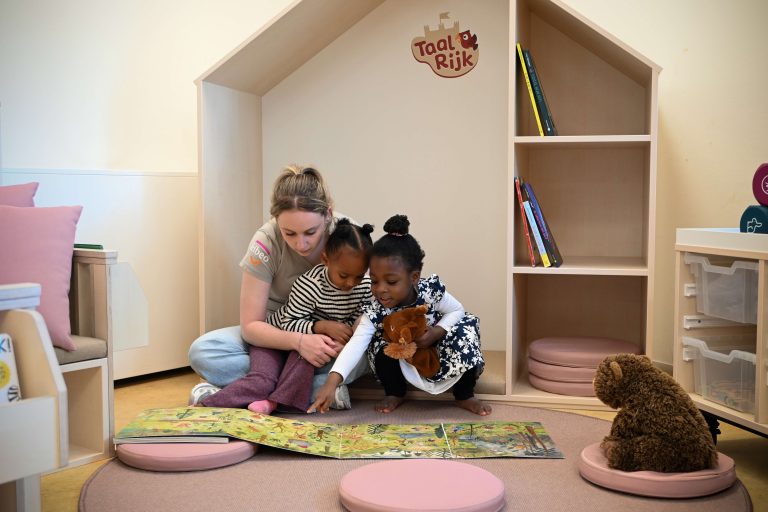
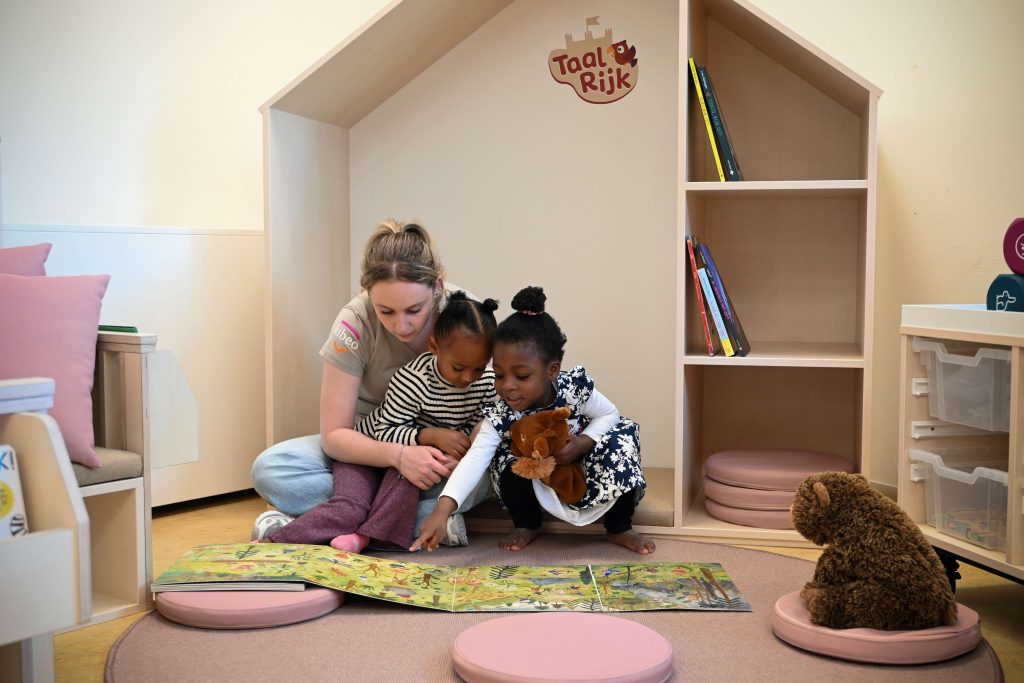
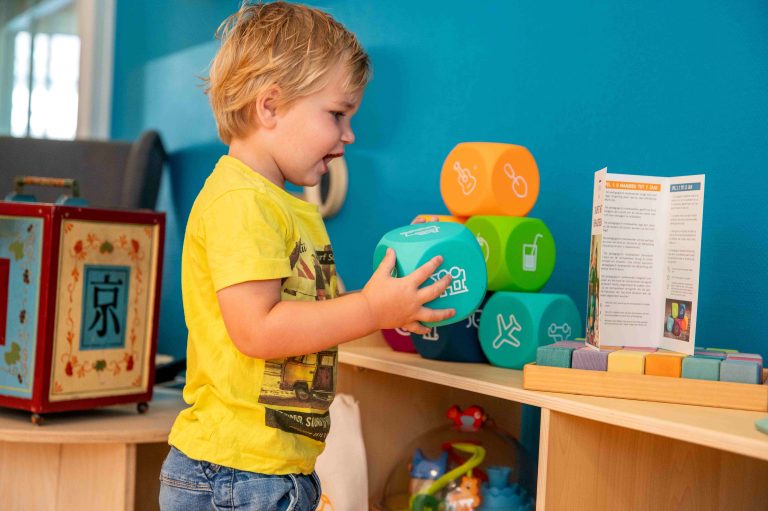
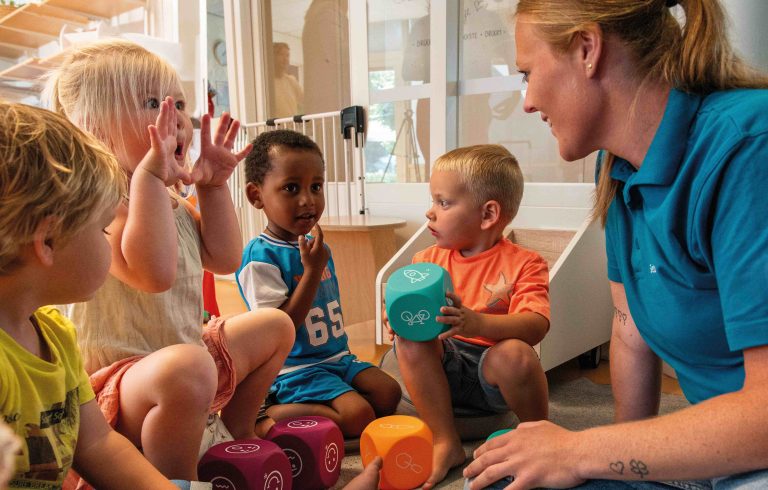
A visible part of Taalrijk is the Language Corner: an inviting place in the group where language is naturally encouraged. There, children will find, among other things, a storytelling and discovery area, a cozy reading nook, and materials such as story stonesThese large dice with images invite children to create stories together, listen to each other, and give words to their imagination. In addition, there are materials for letter recognition, for example. These have been carefully selected so that educational professionals can work on all language developmental goals in a playful manner.
Taalrijk goes beyond the classroom setup. Danina explains: “We want language to develop into something you experience together, not something you only offer in an activity. That is why all pedagogical professionals at Kibeo receive training, in which they acquire knowledge and skills, as well as inspiration and ideas, to stimulate language in a playful and conscious way. And because language development does not stop in the group, parental involvement is also an integral part of Taalrijk.”
Language-rich for home
To strengthen the connection between home and childcare, Taalrijk is also being given a place outside the group. Soon, a special cabinet with play and developmental materials will be located at the entrance of every location. The cabinet is filled with books in various home languages, picture books used in the group, and materials that stimulate language play at home. When parents read aloud in their native language at home and that same book reappears in Dutch in the group, a powerful link is created between both language worlds. In this way, home and childcare reinforce each other.
Language thinking
An important principle of Taalrijk is that children not only learn words, but also learn to put their thoughts into words. This does not happen in planned activities, but during play. Pedagogical professionals are encouraged to play along, without taking over the game. Danina: “Everyone who works with children recognizes the power of a question at the right moment: 'Why doesn't this fit?', 'What do you think will happen if…?', 'How could you solve this?'. Children then start not only talking, but also reasoning. They formulate thoughts, explore possibilities, and test ideas. And that, too, is part of language development.”
Supported by science
To arrive at a well-substantiated program, Kibeo brought together practical experience and science. “We didn’t want a program that was detached from daily practice,” explains Danina. “That is why we started with the group: looking at what is already happening, what works, and how we can reinforce that.” At the same time, based on the literature1,2,3 investigated what is effective with young children. “Meaningful offerings, a positive attitude from the professional, and attention to the home language proved crucial in this,” says Danina.
Scientifically evaluated
To ensure that Taalrijk delivers on its promises, Kibeo had the program evaluated by University Utrecht. “We wanted to be sure that what we do truly aligns with what research shows works,” says Danina. The university assessed the coherence, theoretical basis, and translation into practice, and provided recommendations for refinement. “For instance, we have incorporated attention to multilingualism more explicitly and emphasized the role of interaction between children more,” Danina explains. “You don’t develop language on your own, but always together.”
PhD candidate Vera Snijders from University Utrecht reviewed the development of the program and looks back on the collaboration with appreciation. “I found it impressive how Kibeo translated scientific insights into concrete practice,” says Snijders. “Many components of Taalrijk align well with recent studies, allowing us to provide Danina and her colleagues with primarily substantive confirmation. For me as a researcher, it is valuable to see that scientific insights actually find their way into daily practice. Taalrijk shows how that is possible.” For Danina, the collaboration was a confirmation of the course. “It gave us the assurance that Taalrijk is solid: substantively sound and workable within the group.”
From stimulating to signaling
Language stimulation in Taalrijk is closely interwoven with play, interaction, and daily contact with children. This creates a clear picture of language development. It is precisely because of this that pedagogical professionals can identify early on when a child needs extra support.
Taalrijk is therefore not a standalone program. It is part of the broader care structure of Kibeo, in which early detection and prevention play an important role. At every location, an internal supervisor is involved who monitors the child's development together with the pedagogical professional whenever there are questions or concerns about it. In consultation with parents, observations are discussed and the appropriate support is determined.
Danina: “Often, it is sufficient to deepen or intensify the language input within the group. Because Kibeo works with pre-school education (VE) at all locations, language development can receive targeted extra attention. When it becomes apparent that a child needs more support, the appropriate additional help is determined in consultation with the parents. Children with a VE indication or a language development delay receive an individual action plan.”
Kibeo collaborates with external partners when additional expertise is required. Examples include speech therapy practices or organizations such as Auris, Kentalis, the Center for Youth and Family, and initiatives like the VoorleesExpress. In this way, signals are not only recognized but also followed up, always in close cooperation with parents. By systematically monitoring and reinforcing language development, space is created to support children in a timely manner.
Experiencing language, growing together
Taalrijk demonstrates how language development, prevention, and early detection can be interconnected in childcare. By making language a natural part of play, interaction, and collaboration with parents, space is created for every child to develop at their own pace. In doing so, Taalrijk contributes to equal opportunities, particularly during the years that are essential for a child's (language) development.
This article appeared in the June (2026) edition of Early Childhood Education Journal.
Curious about more articles from Vakblad Vroeg? View the subscriptions via: https://www.vakbladvroeg.nl/abonneren/