

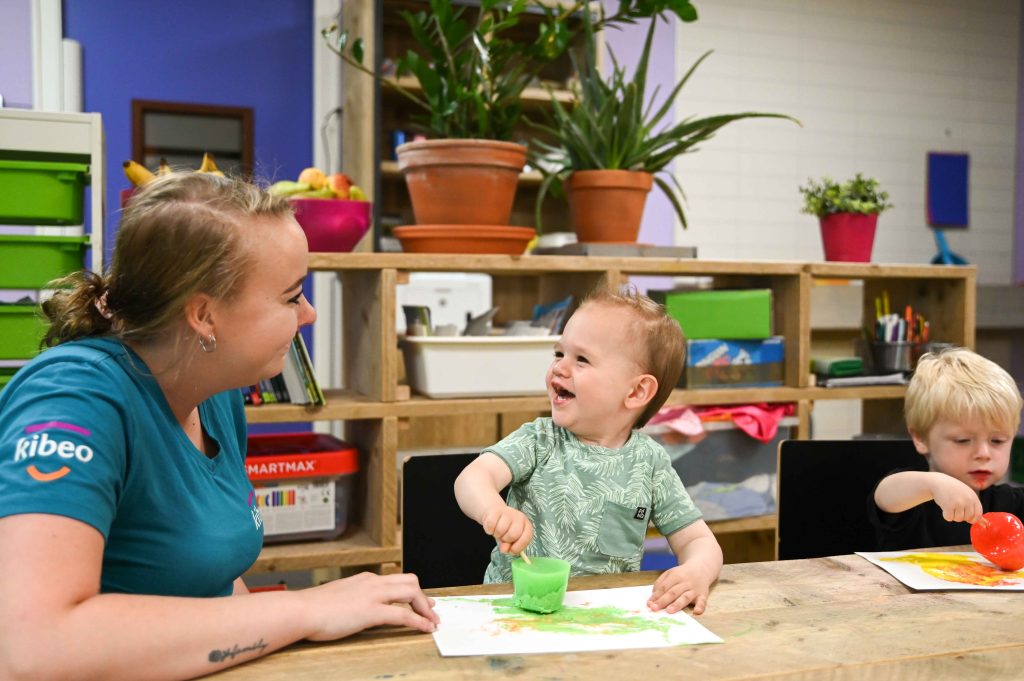

Looking something up quickly, answering a message fast, capturing that beautiful moment when your child takes their first steps, or scrolling out of habit. Screens are part of our daily lives. Even when you are with your child. But it is precisely those moments together that are important for the connection between you and your child. Think of eating together, reading aloud, playing, or having a quick chat. Your child seeks a connection with you at those times.
What does research say about parents' smartphone use?
Tilburg University recently investigated what happens when parents divide their attention between their child and their smartphone. In the study, mothers played with their babies and repeatedly glanced at their phones briefly in between. As a result, the babies became visibly upset. After multiple interruptions, some babies even struggled to calm down again, even after contact between mother and child had been restored. Once the baby received genuine attention and interaction again, contact was restored.
Why is attention important for young children?
When parent and child look at each other, talk to each other, or touch each other lovingly, their brains attune to one another. This means that the same brain areas become active at approximately the same time. This is called brain-to-brain synchrony. The study showed that this attunement between mother and child decreased at the moments the mother was paying attention to her phone. When the baby received attention again, contact was restored and the connection returned as well. This shows how important attention and interaction are for young children.
Why does your child want to be seen and feel heard?
When you look at your phone, you are briefly occupied with something else. That is logical, but for your child, this sometimes feels like you are interrupting contact. Young children, in particular, do not yet fully understand why your attention is suddenly elsewhere. Your child seeks contact in all sorts of ways: by pointing at something, by babbling, by smiling at you, or by telling you something. Essentially, your child is asking: “Are you looking with me?” or “Are you listening to me?” When you respond, your child feels seen and heard, and that builds trust.
How does attention help with your child's language development?
Attention and interaction are also important for both your child's social-emotional and language development. During moments spent together, your child learns new words, emotions, and social skills. In this way, your child also develops through contact with others. His or her self-confidence also grows through interaction. This is especially important for babies and toddlers. They learn a lot from your face, your voice, and your reaction. A smile, eye contact, or a calm answer helps your child connect and understand the world better.
How do you manage screen time consciously as a parent?
Are you not responding for a moment because you are looking at your phone? Then that can feel like a real interruption of contact to your child. This can cause frustration. It does not mean that one moment is immediately harmful. However, it does show how important conscious attention is. Screens are part of our society. They are convenient and belong to this era. So it is not about banning, but about balance. Especially during moments that revolve around contact, it helps to give your child conscious attention. For example, during playtime, eating, reading aloud, or a quick chat. There is great value in precisely those small moments. You don't have to make a big deal out of it. Just looking at what your child is pointing at. Responding to a sound or a word. Naming what your child sees, feels, or experiences is sometimes enough. In this way, an ordinary moment becomes a valuable moment of connection.
How does Kibeo stimulate language development?
At Kibeo, we also know how important attention, language, and interaction are. That is why we work with Language-rich: Kibeo's own language programCommunication and language-rich interactions are central to this program. Our pedagogical professionals make conscious contact with your child. They listen, observe, and respond to what your child shows, says, or feels. In this way, your child is given the space to discover language and develop further.
We do this, for example, by:
- to make eye contact and listen attentively
- to respond to signals such as crying, laughing, eye contact, searching, and pointing
- to ask open questions
- to name what your child sees, feels, and experiences
- to play together and add language
- to provide a language-rich environment with books, songs, and developmental materials
Whether it’s a quick chat, a circle time, or reading a book together: it’s always about interaction. Your child learns language not only by hearing words, but especially by experiencing them together.
Source: Heuvel MI, Mosińska A., Turk E. et al. Maternal technoference decreases brain-to brain synchrony during mother-infant interaction. Sci Rep (2026). https://doi. org/10.1038/s41598-026-37037-5